Mastering Freight Marketing ROI

Freight forwarding companies are indispensable in the global logistics industry and come in handy to businesses in the movement of goods from one location to another. The biggest challenge that a lot of freight forwarding companies face in this digital age is how to track and measure the success of their digital marketing efforts.
If one doesn’t have the right data, they cannot have insight into whether their marketing campaigns create value or drive a good ROI. This is especially critical in a competitive field like freight forwarding, where having a comprehensive digital marketing approach can be the key differentiator between businesses that thrive and those that merely survive.
Below, we dive deeper into some freight forwarding marketing strategies, along with best practices and tips that you can draw from to maximize impact. We will also provide actionable steps on how to ensure you can measure and track your ROI, helping you grow your business sustainably.
1. Develop a Focused and Measurable Digital Marketing Strategy:
Why it’s important: A clear strategy ensures you invest your efforts in the activities that drive the best results for your business.
The only way freight forwarders can measure the true effectiveness of ROI is by first developing a well-defined marketing strategy with specific goals. That might sound straightforward, yet too many companies dive into marketing headfirst without a proper roadmap. This can make it hard to understand which tactics are working and which ones aren’t.
Here’s how to set up a freight forwarding marketing strategy for success:
A. Establish clear goals:
Decide whether you want to increase leads, improve website traffic, boost brand awareness, or enhance customer retention. A business without clear objectives tends to spread resources thinly across too many activities, leading to poor results.
B. Establish KPIs:
KPIs help quantify the success of your campaigns. Relevant KPIs for freight forwarders might include new leads, website visits, or customer inquiries. Tracking these will give you a more accurate view of how your marketing efforts translate into tangible business outcomes.
C. SMART goals:
Ensure your goals are specific, measurable, achievable, relevant, and time-bound. Instead of saying, “We want more leads,” a SMART goal would be, “We want to generate 20 qualified leads each month within the next quarter.”
Having clear goals and KPIs leads to a stronger understanding of the results of freight forwarding marketing strategies. Knowing what to measure will provide insights into how marketing investments translate into real business outcomes.
2. Optimize Your Website for Search Engines (SEO):
Why it’s important: SEO is one of the most powerful ways to attract organic traffic to your website, making it one of the most cost-effective forms of digital marketing.
Search engine optimization, or SEO, is a crucial aspect for freight forwarders. The main reason is that most customers begin their search for logistics solutions online. Your website will show up more in search engine results if it is optimized for potential customers. Unlike paid advertising, SEO offers long-term benefits that continuously bring in traffic without requiring a daily ad spend.
Here’s how to effectively use SEO in your freight forwarding marketing strategy:
A. Keyword Research:
Identify the search terms your target audience uses. These may include keyword phrases like “freight forwarding services,” “international shipping,” or “logistics solutions.”
B. On-page SEO:
Your website content, meta descriptions, and headers should be optimized with the right keywords to enhance your search rankings. Other crucial factors include page speed, mobile-friendliness, and URL structure.
C. Off-page SEO:
Build backlinks from reputable sources within your industry. Backlinks signal to search engines that your content holds value, which in turn helps drive up your rankings.
Measuring the return on investment of SEO can be done through tools like Google Analytics and Google Search Console, focusing on tracking organic traffic, keyword performance, and user interaction on your website. Success is measured through improvements in search engine rankings, increases in organic traffic, and the conversion of visitors into leads or customers.
3. Employ Pay-Per-Click Advertising for Fast Outcomes:
Why it’s important: With PPC, you can target specific audiences and drive instant traffic—a perfect complement to SEO.
Unlike SEO, which takes time to yield results, PPC advertising delivers fast, traceable traffic to your website. You can run ads on Google Ads or LinkedIn Ads to target specific demographics, locations, and industries, ensuring your message reaches those most likely to convert.
Best practices for PPC in freight forwarding marketing strategies:
A. Choose Relevant Keywords:
Target high-intent keywords related to freight forwarding, logistics, or shipping services. For instance, “freight forwarding companies near me” should drive traffic from users with a strong intention to act.
B. Set a Budget:
PPC can become costly if not managed carefully. Set a maximum cost-per-click (CPC) and monitor your ad spending to ensure you remain within budget.
C. Value Proposition:
Your ad copy should clearly explain why customers should choose your freight services. Use strong calls-to-action (CTAs) to encourage clicks and conversions.
Measuring ROI for PPC involves tracking metrics such as cost-per-click, conversion rates, and return on ad spend (ROAS). Fortunately, most PPC platforms offer detailed insights, enabling you to easily track your spending and performance. The higher your ROAS, the more cost-effective your campaign.
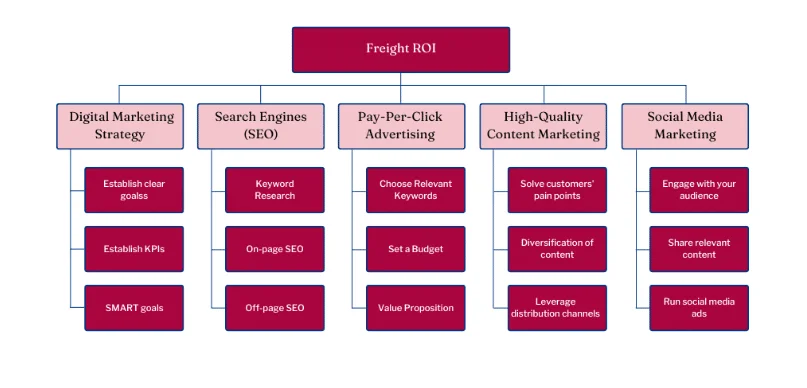
4. Invest in High-Quality Content Marketing:
Why it’s important: Valuable content builds trust and authority—helping you engage with future customers and retain your existing ones.
For freight forwarders, some of the most effective long-term freight forwarding marketing strategies revolve around content marketing. This involves creating valuable and educational content, which positions your company as a thought leader in the logistics industry. Content can take many forms, such as blog posts, case studies, videos, or white papers. Through content marketing, you can engage your target audience and nurture leads.
Key content strategies for freight forwarders:
A. Solve customers’ pain points:
Many freight forwarders support their customers with complex logistics challenges, such as customs regulations, cross-border shipping, and warehousing. Create content that addresses these pain points and provides valuable solutions.
B. Diversification of content:
Blog posts are just one type of content. Consider creating eBooks, infographics, case studies, and video tutorials that demonstrate your expertise in logistics.
C. Leverage distribution channels:
To maximize your content’s reach, employ multiple distribution channels like SEO, social media, and email marketing. Optimizing content for search engines ensures visibility to potential clients searching for logistics solutions, while social media and email help maintain continuous engagement.
To maximize the reach of your content, use SEO, social media, and email marketing as distribution channels. Measuring the return on investment for content marketing involves tracking metrics like time spent on a page, bounce rates, and social shares. You can also monitor how content influences lead generation and customer conversions to determine its contribution to your ROI.
5. Leverage Social Media Marketing:
Why it’s important: Social media is an excellent way to directly engage with your audience, build relationships, and promote your services.
Social media platforms such as LinkedIn, Facebook, and Instagram allow freight forwarders to connect with potential clients on a more personal level. This is a powerful tool for marketing, enabling you to engage prospects, distribute industry news, promote content, and showcase your company’s expertise.
Best practices for social media marketing:
A. Engage with your audience:
Respond to comments and messages as quickly as possible. Freight forwarders may have complex questions about your services, and providing prompt, helpful responses builds trust.
B. Share relevant content:
Distribute blog posts, case studies, and company news to keep your audience informed and engaged.
C. Run social media ads:
If your organic reach isn’t delivering the desired results, consider running paid ads on platforms like LinkedIn or Facebook to broaden your audience.
Tracking social media ROI involves monitoring metrics such as engagement rates, click-through rates, and follower growth. Most social media platforms offer built-in insights that allow you to see how your posts and ads are performing, enabling you to optimize your campaigns for better results.
Conclusion:
Digital marketing can truly revolutionize the business of every freight forwarder, but success depends on implementing freight forwarding marketing strategies that are measurable and flexible. Populate your strategy with proven digital marketing tactics like SEO, pay-per-click advertising, content marketing, and marketing automation to drive real value in leads, customer engagement, and revenue.
Measuring ROI may seem complex, but with the right tools and approach, it becomes straightforward and essential for tracking continuous performance. By refining your tactics, you can ensure that significant business growth follows from your marketing investments.
Ready to amplify your digital marketing endeavors? Contact us today to learn how we can help you develop a tailored digital marketing strategy that creates measurable results for your freight forwarding business.